

RLAIF vs RLHF: What AI Feedback Can and Cannot Replace


Where AI feedback can scale post-training supervision, and where human-grounded objectives, calibration, expert review, and holdouts remain essential.
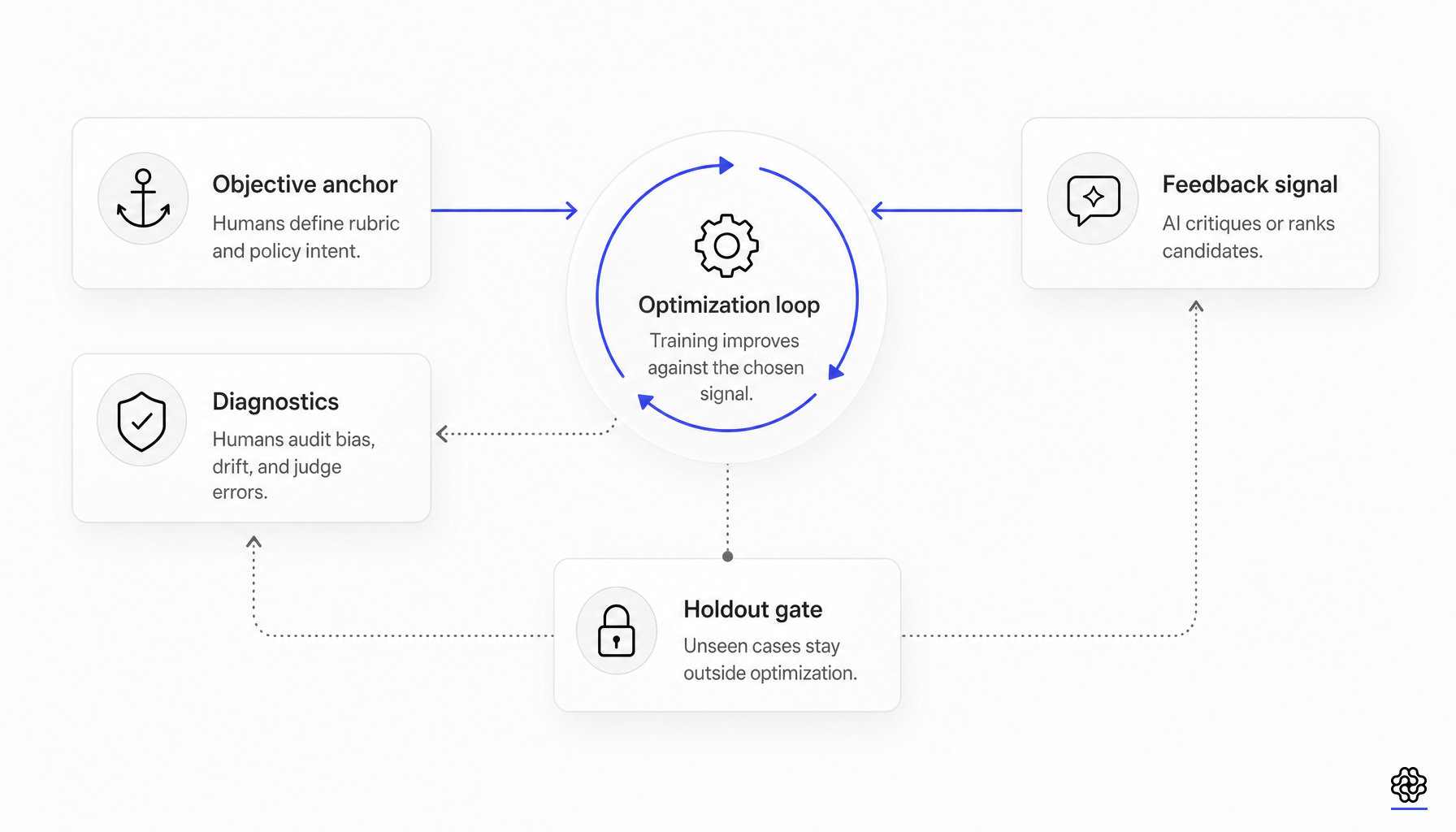
RLAIF is not replacing RLHF in the strong sense that headlines imply. As of June 4, 2026, the strongest public evidence supports a narrower and more useful claim: AI feedback can often substitute for one expensive middle layer in post-training, namely large-scale critique generation, pairwise preference labeling, and some iterative policy-improvement loops.
But the same literature also shows repeated failures when teams treat the synthetic evaluator as ground truth. Reward models that score well on static benchmarks can fail to predict downstream human preference. LLM judges can be only marginally above random on correctness-centric comparisons or unstable on long-form outputs. Synthetic preference mixtures can improve broad capability benchmarks while degrading safety behavior under jailbreak pressure. The operational question is not whether AI feedback can stand in for human feedback. It is where AI feedback is a productive optimization signal, and where humans must remain the objective setter, calibrator, adversary, and final measurer (RLAIF vs RLHF, JudgeBench, More is Less).
What the direct RLAIF comparison actually shows
The most defensible pro-RLAIF result is still the 2023 Google comparison. In that study, humans preferred both RLAIF and RLHF over the SFT baseline by similar margins on summarization and helpful dialogue, with no statistically significant difference between RLAIF and RLHF, and RLAIF scored higher harmlessness in the harmless-dialogue setup. The same paper warns that high-stakes domains such as medicine, law, and employment should still treat trained human experts as the gold standard.
That boundary matters. The experiment shows that AI-generated preferences can replace a large block of preference-label production in some regimes. It does not show that human evaluation disappears. Humans still decide whether the resulting policy is actually better.
Anthropic’s original Constitutional AI work makes the same point in a different form. Constitutional AI reduces the need for humans to label every harmful output directly, but it compresses human intent into a written constitution: principles that guide self-critiques, revisions, and AI-generated preference rankings. Anthropic’s 2026 constitution update and Claude 4 system card describe hybrid training and evaluation stacks involving human feedback, Constitutional AI, data-labeling services, contractors, crowd-worker preference selection, expert red teaming, adversarial testing, hidden tests, and ongoing monitoring (Constitutional AI, Claude’s new constitution, Claude 4 system card).
The real substitution boundary is narrower than 'AI stands in for human feedback.'
| Pipeline family | What humans still supply | What AI feedback can scale | Where it tends to work best | What it does not replace |
|---|---|---|---|---|
| RLHF | Demonstrations, pairwise preferences, rater policy, eval design | Limited assistance in triage or pre-filtering | General instruction-following when latent preference needs direct human grounding | Human objective definition, evaluator calibration, adversarial testing, holdout measurement |
| RLAIF | Task framing, rubric or policy intent, AI-labeler choice, final evaluation | Pairwise rankings, scalar rewards, some direct online rewards, faster iteration | Cases where 'better' can be legibly expressed and a stronger judge is available | Gold-standard evaluation, domain-expert adjudication, unseen edge-case review |
| Constitutional AI | Constitution or principles, policy boundaries, exception handling | Self-critiques, revisions, constitution-guided rankings, synthetic conversations | Safety and refusal style where values can be written down as principles | Whether the constitution is complete, well-prioritized, or robust to adversaries |
| Model-generated critiques | Seed preference data, critique rubrics, quality filters | Natural-language critiques that enrich reward-model or policy training | Data efficiency, critique generation, richer supervision than scalar-only RMs | Robustness to distribution shift without holdouts and human audit |
| Model-graded training and eval | Human-written rubrics, ground-truth grades, hidden tests, grader meta-evals | Cheap repeated scoring during training or large-scale offline eval | Narrow, well-specified tasks with low-noise rubrics | Independent measurement of real-world behavior without human grounding |
RLHF
- What humans still supply
- Demonstrations, pairwise preferences, rater policy, eval design
- What AI feedback can scale
- Limited assistance in triage or pre-filtering
- Where it tends to work best
- General instruction-following when latent preference needs direct human grounding
- What it does not replace
- Human objective definition, evaluator calibration, adversarial testing, holdout measurement
RLAIF
- What humans still supply
- Task framing, rubric or policy intent, AI-labeler choice, final evaluation
- What AI feedback can scale
- Pairwise rankings, scalar rewards, some direct online rewards, faster iteration
- Where it tends to work best
- Cases where 'better' can be legibly expressed and a stronger judge is available
- What it does not replace
- Gold-standard evaluation, domain-expert adjudication, unseen edge-case review
Constitutional AI
- What humans still supply
- Constitution or principles, policy boundaries, exception handling
- What AI feedback can scale
- Self-critiques, revisions, constitution-guided rankings, synthetic conversations
- Where it tends to work best
- Safety and refusal style where values can be written down as principles
- What it does not replace
- Whether the constitution is complete, well-prioritized, or robust to adversaries
Model-generated critiques
- What humans still supply
- Seed preference data, critique rubrics, quality filters
- What AI feedback can scale
- Natural-language critiques that enrich reward-model or policy training
- Where it tends to work best
- Data efficiency, critique generation, richer supervision than scalar-only RMs
- What it does not replace
- Robustness to distribution shift without holdouts and human audit
Model-graded training and eval
- What humans still supply
- Human-written rubrics, ground-truth grades, hidden tests, grader meta-evals
- What AI feedback can scale
- Cheap repeated scoring during training or large-scale offline eval
- Where it tends to work best
- Narrow, well-specified tasks with low-noise rubrics
- What it does not replace
- Independent measurement of real-world behavior without human grounding
OpenTrain synthesis from RLAIF vs RLHF, Constitutional AI, Anthropic public system documentation, and OpenAI grader/RFT documentation.
Why AI feedback scales
Modern post-training often benefits from structured intermediate supervision rather than raw human preference tuples alone. UltraFeedback showed that a large AI-feedback dataset could be constructed at scale: around 64,000 prompts, four completions per prompt, and more than one million GPT-4 feedback annotations over 250,000 conversations (UltraFeedback).
Subsequent work moved beyond scalar pairwise wins. Synthetic-critique methods showed that model-generated natural-language critiques can improve reward-model robustness and data efficiency. Critic-RM reported 3.7 to 7.3 point accuracy gains over standard reward models and LLM judges by jointly training reward prediction and critique generation. NVIDIA’s HelpSteer3 line pushed the same idea in a more human-grounded direction: human feedback and edit data train dedicated feedback/edit models, while HelpSteer3-Preference adds more than 40,000 human-annotated preference samples across STEM, coding, and multilingual settings (synthetic critiques, Critic-RM, HelpSteer3, HelpSteer3-Preference).
These Bradley-Terry style formulations remain the basic abstraction behind many reward-model pipelines:
Preference supervision is then often fit with a loss of this form:
The practical failure point is usually not the math. It is whether the dataset, reward function, and downstream deployment distribution still reflect the same objective once optimization pressure begins (reward model overoptimization, constrained RLHF).
Where AI feedback fails first
The central reason RLAIF cannot serve as the human measurement layer is benchmark transfer. Preference Proxy Evaluation (PPE) is especially useful here because it asks the right question: not “does the reward model look good offline,” but “does it produce stronger post-RLHF models under human preference.” PPE reports that the original RewardBench could even become negatively correlated with downstream post-DPO human preference on top models, and that fine-grained accuracy on diverse human-preference and correctness datasets was more predictive of downstream Chatbot Arena outcomes than rank-correlation style metrics. PPE tied those findings to 12,190 human votes on post-trained models (How to Evaluate Reward Models for RLHF).
RewardBench 2 should be read as a response to that failure, not a contradiction of it. RewardBench 2 introduces unseen human prompts, best-of-4 evaluation, and six domains. It reports that models score roughly 20 points lower than on the original RewardBench while achieving better downstream correlation. But it is explicit that a high benchmark score is only a prerequisite, not a sufficient condition for good RLHF, and that the best reward model for RLHF depends on training setup and model lineage (RewardBench 2).
LLM judges show the same pattern. JudgeBench was built because human-preference agreement alone was too weak a target for correctness-heavy tasks, and it found that many strong judge models were only slightly above random on difficult objective-correctness response pairs. Separate judge-bias work catalogs position bias, verbosity bias, self-preference, and other shortcuts. LongJudgeBench extends the problem into long-form evaluation, where rubrics and references help but do not eliminate instability (JudgeBench, judge bias, LongJudgeBench).
Failure modes that make AI feedback a poor measurement anchor.
| Failure mode | Representative evidence | Why AI feedback mispredicts | Mitigation pattern | What remains human-anchored |
|---|---|---|---|---|
| Offline RM benchmark looks good, policy disappoints | PPE vs original RewardBench | Benchmark signal is not tightly linked to post-training human preference | Use unseen prompts, correctness + human-preference mixes, and downstream holdouts | Final human preference measurement |
| Judge prefers style over substance | RM-Bench and judge-bias studies | Style cues, verbosity, position, and self-preference act as shortcuts | Randomize order, run style-control analyses, tighten rubrics | Bias adjudication and meta-eval design |
| Long-form judge instability | LongJudgeBench | Context and protocol complexity exceed judge robustness | Use task-specific rubrics, chunking, references, and human spot checks | Long-form quality judgment |
| Multi-model synthetic preferences weaken safety | More is Less | Model optimizes separable superficial cues rather than robust safety constraints | Use tighter data curation, safety-specific evals, and adversarial jailbreak testing | Safety acceptance criteria |
| Self-critique shifts off-policy | SCOP | Critiques are generated on a distribution no longer matching the current policy | Generate critiques on-policy and use multi-objective rewards | Selection of objectives and failure review |
| RL reward hacking | Claude 4 system card and overoptimization work | Proxy reward can be gamed under optimization pressure | Use hidden tests, monitors, reward constraints, and rapid human review | Detecting and redefining failure cases |
Offline RM benchmark looks good, policy disappoints
- Representative evidence
- PPE vs original RewardBench
- Why AI feedback mispredicts
- Benchmark signal is not tightly linked to post-training human preference
- Mitigation pattern
- Use unseen prompts, correctness + human-preference mixes, and downstream holdouts
- What remains human-anchored
- Final human preference measurement
Judge prefers style over substance
- Representative evidence
- RM-Bench and judge-bias studies
- Why AI feedback mispredicts
- Style cues, verbosity, position, and self-preference act as shortcuts
- Mitigation pattern
- Randomize order, run style-control analyses, tighten rubrics
- What remains human-anchored
- Bias adjudication and meta-eval design
Long-form judge instability
- Representative evidence
- LongJudgeBench
- Why AI feedback mispredicts
- Context and protocol complexity exceed judge robustness
- Mitigation pattern
- Use task-specific rubrics, chunking, references, and human spot checks
- What remains human-anchored
- Long-form quality judgment
Multi-model synthetic preferences weaken safety
- Representative evidence
- More is Less
- Why AI feedback mispredicts
- Model optimizes separable superficial cues rather than robust safety constraints
- Mitigation pattern
- Use tighter data curation, safety-specific evals, and adversarial jailbreak testing
- What remains human-anchored
- Safety acceptance criteria
Self-critique shifts off-policy
- Representative evidence
- SCOP
- Why AI feedback mispredicts
- Critiques are generated on a distribution no longer matching the current policy
- Mitigation pattern
- Generate critiques on-policy and use multi-objective rewards
- What remains human-anchored
- Selection of objectives and failure review
RL reward hacking
- Representative evidence
- Claude 4 system card and overoptimization work
- Why AI feedback mispredicts
- Proxy reward can be gamed under optimization pressure
- Mitigation pattern
- Use hidden tests, monitors, reward constraints, and rapid human review
- What remains human-anchored
- Detecting and redefining failure cases
OpenTrain synthesis from PPE, RM-Bench, JudgeBench, LongJudgeBench, More is Less, SCOP, Anthropic Claude 4, and reward-overoptimization papers.
Two failures deserve emphasis because they are easy to miss when teams celebrate synthetic-data scale. First, more synthetic diversity can produce worse safety alignment. “More is Less” isolates data source from optimization method and finds that multi-model synthetic preference data improves several general benchmarks while increasing jailbreak attack success rates, whereas self-generated responses filtered by a reward model produce materially lower ASR across multiple model families. Second, self-critique pipelines drift off-policy. SCOP shows that models in later rounds critique previous-round reasoning more effectively than their own current outputs. The fix is not more automation in the abstract; it is tighter coupling between the evaluator and the actual training distribution, plus adversarial and holdout evaluation that stays external to the optimization loop (More is Less, SCOP).
The strongest counterexample is rubric-bound
HealthBench is the strongest counterexample, and therefore the most instructive one. It does not show that AI graders replace experts. It shows the conditions under which they can approximate expert measurement.
HealthBench comprises 5,000 realistic conversations and 48,562 physician-written rubric criteria, developed with 262 physicians across 60 countries. GPT-4.1 is then used as a model-based grader against those physician-written criteria. On the consensus subset, GPT-4.1 exceeded the average physician MF1 score in five of seven themes, sat in the upper half of physicians in six of seven, and remained above the lower third for all themes. OpenAI attributes that success to diverse and well-annotated ground truth, well-designed meta-evaluation, and careful prompt and grader selection (HealthBench, HealthBench paper).
That is the right read for model grading more generally. AI judges work best when humans have already done the harder work of defining the rubric, selecting criteria, validating grader behavior, and constraining the domain.
Production evidence points to hybrid evaluator stacks
Inference from public documentation suggests that frontier labs have already converged on hybrid evaluator stacks. Anthropic’s public materials say Claude 4 training used both human feedback and Constitutional AI; its system card describes data-labeling services, contractors, crowd workers for preference selection and adversarial testing, SME-informed prompt sets, human raters for ambiguous-context judgments, expert red teaming, hidden tests, and a rapid-response human program for reward hacks. OpenAI’s public reinforcement fine-tuning docs elevate model graders to first-class training components, but they also instruct teams to collect trusted ground-truth grades from human experts and to detect grader hacking by comparing model-grader scores against expert human evaluation (OpenAI graders, reinforcement fine-tuning).
For non-frontier teams, the implication is that human feedback should move up the stack, not disappear from it. The highest-value work now comes from specialist humans writing or approving rubrics and constitutions, calibrating evaluators against hard cases, reviewing judge-policy disagreements, creating adversarial and holdout sets, and adjudicating domains where correctness is sparse, multi-objective, or safety-sensitive. AI feedback can then do repetitive work in between: generating critiques, ranking candidates, expanding preference coverage, or serving as a fast inner-loop grader.
Open questions remain. The literature is still moving on personalized reward modeling, long-form judging, whether same-lineage reward models matter for PPO-like training, and how far critique-specialized models can generalize outside the seed domains that trained them. But the center is stable: RLAIF is best understood as a way to scale supervision once humans have already grounded the target, not a way to eliminate the need for human-grounded targets or human-grounded measurement (Personalized RewardBench).
OpenTrain can source specialist evaluators and preference-data operators inside the stack a team already uses. Use the DPO vs PPO reference for optimizer-versus-measurement context, the LLM judge reliability reference for evaluator calibration, the RLHF scoping guide for preference-data planning, and post a job when the bottleneck is staffing the review loop.
Sources
- RLAIF vs. RLHF: Scaling Reinforcement Learning from Human Feedback with AI Feedback
- Constitutional AI: Harmlessness from AI Feedback
- Claude’s new constitution
- Claude 4 System Card
- UltraFeedback
- Improving Reward Models with Synthetic Critiques
- Self-Generated Critiques Boost Reward Modeling for Language Models
- HelpSteer3
- HelpSteer3-Preference
- How to Evaluate Reward Models for RLHF
- RewardBench 2
- RM-Bench
- JudgeBench
- Justice or Prejudice? Quantifying Biases in LLM-as-a-Judge
- Benchmarking LLM-as-a-Judge for Long-Form Output Evaluation
- HealthBench
- HealthBench paper
- OpenAI grader guidance
- OpenAI reinforcement fine-tuning guidance
- More is Less
- Fixing Distribution Shifts of LLM Self-Critique via On-Policy Training
- Scaling Laws for Reward Model Overoptimization
- Confronting Reward Model Overoptimization with Constrained RLHF
- Personalized RewardBench